Diane Donathan Breaks Barriers with Her Bare Hands
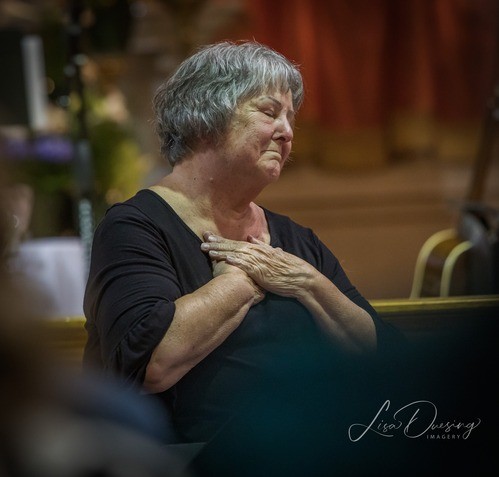
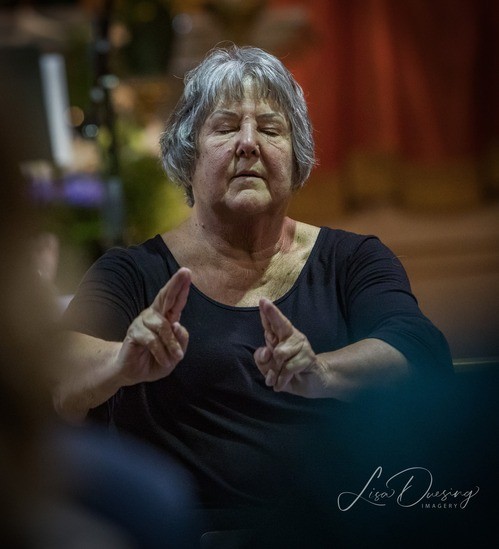
In a world full of noise, the most powerful messages often come cloaked in quiet. Diane Donathan is a perfect example of this as she interprets the Mass in American Sign Language (ASL) at Mother of God on Sunday mornings. Though she doesn’t speak a word, her face is alight with expression, and her fingers fly to keep up with the passionate pace of a homily or the steady beat of a song. The effect is mesmerizing, inviting the congregation to experience the Word of God on an entirely different level.
On Thanksgiving Day, she celebrated 40 years of making the Good News more accessible to the Deaf community at Mother of God and building a culture of inclusion in the Catholic Church.
Diane’s first exposure to ASL interpretation was a fluke, she says. “I was friends with Judy Kinman. It was September 1985, and Mary Ann Barth, who directed the Deaf Ministry Office for the Diocese of Covington, was teaching ASL classes at St. Paul’s Church in Florence. Judy and I decided to take the class. It was very informal—there were no grades or tests. A couple of months after we signed up, Mary Ann asked if Judy and I would be interested in interpreting at Mother of God. My first day was Thanksgiving 1985. We didn’t know what we were doing, but that didn’t stop us.”
In the beginning, Diane signed the congregation’s responses, since the words don’t change and can be rehearsed. She honed her skills over the next two years with more classes at St. Paul’s and practice sessions with Mary Ann Taylor, a Deaf friend who loves to talk, says Diane.
“I would go to her house, and before we’d start our conversation, she put a pen and piece of paper in front of me, saying that if I got to a place where I didn’t know how to sign something, I could write it down,” Diane recalls. “But whenever I reached for the paper, she would lightly tap my hand and say, ‘Figure it out.’ That was an effective way of helping me improve.”
Diane expanded her ASL interpretation as a freelancer, helping people with physician consultations, job interviews and sessions with mental health providers—all situations that required confidentiality and building trust with her clients. She enjoyed that work, but she scaled it back in 1992 when she returned to college to get her master’s degree in counseling.
Signing at Mass remained a constant though, and when the Deaf Ministry Office closed in the early 2000s, Mother of God’s pastor, Fr. Ray Hartman, decided to continue funding the ASL program for the parish.
Says Diane, “It was, and is, an incredibly wonderful thing Mother of God has done by keeping the Deaf ministry going. No one requested that they take it over. Leadership just stepped up, and now we are the only church in Northern KY to provide this service.”
On Thanksgiving Day, she celebrated 40 years of making the Good News more accessible to the Deaf community at Mother of God and building a culture of inclusion in the Catholic Church.
Diane’s first exposure to ASL interpretation was a fluke, she says. “I was friends with Judy Kinman. It was September 1985, and Mary Ann Barth, who directed the Deaf Ministry Office for the Diocese of Covington, was teaching ASL classes at St. Paul’s Church in Florence. Judy and I decided to take the class. It was very informal—there were no grades or tests. A couple of months after we signed up, Mary Ann asked if Judy and I would be interested in interpreting at Mother of God. My first day was Thanksgiving 1985. We didn’t know what we were doing, but that didn’t stop us.”
In the beginning, Diane signed the congregation’s responses, since the words don’t change and can be rehearsed. She honed her skills over the next two years with more classes at St. Paul’s and practice sessions with Mary Ann Taylor, a Deaf friend who loves to talk, says Diane.
“I would go to her house, and before we’d start our conversation, she put a pen and piece of paper in front of me, saying that if I got to a place where I didn’t know how to sign something, I could write it down,” Diane recalls. “But whenever I reached for the paper, she would lightly tap my hand and say, ‘Figure it out.’ That was an effective way of helping me improve.”
Diane expanded her ASL interpretation as a freelancer, helping people with physician consultations, job interviews and sessions with mental health providers—all situations that required confidentiality and building trust with her clients. She enjoyed that work, but she scaled it back in 1992 when she returned to college to get her master’s degree in counseling.
Signing at Mass remained a constant though, and when the Deaf Ministry Office closed in the early 2000s, Mother of God’s pastor, Fr. Ray Hartman, decided to continue funding the ASL program for the parish.
Says Diane, “It was, and is, an incredibly wonderful thing Mother of God has done by keeping the Deaf ministry going. No one requested that they take it over. Leadership just stepped up, and now we are the only church in Northern KY to provide this service.”
What It Takes
The role of the ASL interpreter is complex, especially at Mass.
“You have to interpret from your toes,” Diane explains. “It’s not just spelling out words. You must convey intensity, emotion and tone of voice—all the nuances that make the meaning of the message clearer.
“Interpreting music is especially challenging. The lyrics contain a lot of metaphors—sometimes four to a verse, all related to one concept—that don’t translate into ASL. I can repeat the concept four times, but that’s boring. So, to make it more interesting, I think about what the metaphor relates to or what scripture verse it’s based on, which helps me to figure out how to sign it more creatively.”
Making the message come alive requires a sense of abandon.
“When the Deaf community sees certain songs on the Mass program, they smile because they know I’m going to dance” says Diane. “I’ve seen photos of myself interpreting where I look somewhat deranged. But the more you can embody the message on your face and in your movements, the better it is.”
For this reason, during the COVID pandemic, the signers pushed back on having to wear masks because blocking facial expressions and mouthing of words makes it harder to get the message across.
“You have to interpret from your toes,” Diane explains. “It’s not just spelling out words. You must convey intensity, emotion and tone of voice—all the nuances that make the meaning of the message clearer.
“Interpreting music is especially challenging. The lyrics contain a lot of metaphors—sometimes four to a verse, all related to one concept—that don’t translate into ASL. I can repeat the concept four times, but that’s boring. So, to make it more interesting, I think about what the metaphor relates to or what scripture verse it’s based on, which helps me to figure out how to sign it more creatively.”
Making the message come alive requires a sense of abandon.
“When the Deaf community sees certain songs on the Mass program, they smile because they know I’m going to dance” says Diane. “I’ve seen photos of myself interpreting where I look somewhat deranged. But the more you can embody the message on your face and in your movements, the better it is.”
For this reason, during the COVID pandemic, the signers pushed back on having to wear masks because blocking facial expressions and mouthing of words makes it harder to get the message across.
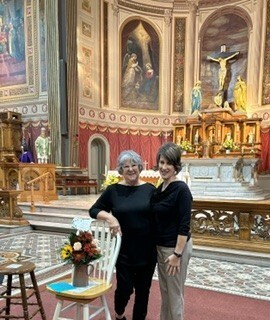
Diane and Jill Twehues at Thanksgiving Day Mass. The interpreters presented her with flowers and a gift certificate for her 40th anniversary.
What It Means
Diane insists that her work as an ASL interpreter has returned far more to her than she has given to others.
“If all my dreams could come true, I would be in musical theater on Broadway,” she says, “but that didn’t happen. Interpreting fulfills a lot of that desire. It is terrifying, and I’ve made a lot of mistakes, but it has also helped me learn.”
“I have to remember that I’m a conduit for information,” she continues. “My mission is to get the intent and meaning of the words across clearly without adding or taking anything away. My own emotion is there, but I have to rein it in. It happens a fair amount of time when I’m signing that, suddenly, the meaning of the words will become clearer because the message is on my hands and not in my brain. It’s like a spiritual lightning bolt, and it knocks my socks off. I am overwhelmed by the grace of getting to use my hands that way. I don’t know where I’d be in life, in my faith, if I didn’t have that.”
“If all my dreams could come true, I would be in musical theater on Broadway,” she says, “but that didn’t happen. Interpreting fulfills a lot of that desire. It is terrifying, and I’ve made a lot of mistakes, but it has also helped me learn.”
“I have to remember that I’m a conduit for information,” she continues. “My mission is to get the intent and meaning of the words across clearly without adding or taking anything away. My own emotion is there, but I have to rein it in. It happens a fair amount of time when I’m signing that, suddenly, the meaning of the words will become clearer because the message is on my hands and not in my brain. It’s like a spiritual lightning bolt, and it knocks my socks off. I am overwhelmed by the grace of getting to use my hands that way. I don’t know where I’d be in life, in my faith, if I didn’t have that.”
Communicating without Words
If you are wondering how you can get to know our Deaf community, Diane Donathan offers these tips:
- Come and sit with them or wave and say hello. It is so appreciated and welcome.
- Sign the alleluia and/or share the Sign of Peace at Mass. It’s a wonderful way to model inclusion.
- When an ASL class is offered, try it out. You will make mistakes, but the Deaf don’t care. During the Lord’s Prayer, I once signed, “and follow us into temptation.” They cracked up and teased me good naturedly.
- If you want to have a conversation with a member of our Deaf community, let a signer know, and they will interpret for you.
- Be willing to step outside your comfort zone. I promise you, it will be a blessing for both parties.