reflections on a fire
By Cindy Duesing
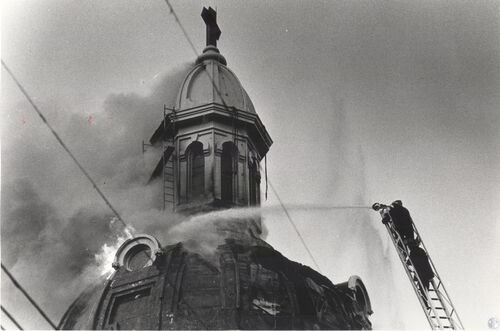
A firefighter sprays water on flames rising from the dome of Mother of God Church on Sept. 25, 1986.
Forty years ago—on the evening of Sept. 25, 1986—Mother of God Church caught fire.
It had already been a rough year for the parish. On Ascension Thursday, 1985, nearby St. Aloysius Church was struck by lightning, its steeple toppling to the ground as it was consumed by flames. After painful consideration, Bishop William Hughes decided not to rebuild the church, and the parish would merge with ours. Naturally, there was a lot of grief and fear to work through as everyone adjusted to the change.
Then, on March 10, 1986, the dome of Mother of God was hit by straight-line winds that sheared off the galvanized steel skin like a tin can. Repairs to the structure took months and were close to being completed in September when—total plot twist here—members of the repair crew accidentally ignited the fire that would start a whole new cycle of upheaval.
Fire crews throughout Northern Kentucky—including Covington, Newport, Erlanger and Ft. Mitchell—poured an estimated 2,000 gallons of water on the dome. Half flowed off the back of the building, while the rest made its way down the interior support columns, causing some of the gilded capitals to crash onto the marble steps and tile floor below.
When the fire was finally extinguished at 11 pm, there was standing water in the undercroft and on the floor of the church. Charred insulation and ash littered the sanctuary and the apex. Saturated bricks bulged behind the mural above St. Joseph’s altar, and white blotches bloomed on the ruined surfaces of the oak altars and communion rail. The walls, once vibrant with color, were gray and streaked with soot. All of this, coupled with the oppressive smell of smoke and burnt wood, made for a massively depressing scene.
But a closer inspection revealed that, despite significant water damage, all the major components of the church survived. It felt like a miracle.
The next morning, parishioners turned out in large numbers to remove pews, pull up carpet and squeegee water and debris out the doors. By the end of the day, the floors and most horizontal surfaces were swept and dry as if to prove that nothing could dampen MoG spirit.
It had already been a rough year for the parish. On Ascension Thursday, 1985, nearby St. Aloysius Church was struck by lightning, its steeple toppling to the ground as it was consumed by flames. After painful consideration, Bishop William Hughes decided not to rebuild the church, and the parish would merge with ours. Naturally, there was a lot of grief and fear to work through as everyone adjusted to the change.
Then, on March 10, 1986, the dome of Mother of God was hit by straight-line winds that sheared off the galvanized steel skin like a tin can. Repairs to the structure took months and were close to being completed in September when—total plot twist here—members of the repair crew accidentally ignited the fire that would start a whole new cycle of upheaval.
Fire crews throughout Northern Kentucky—including Covington, Newport, Erlanger and Ft. Mitchell—poured an estimated 2,000 gallons of water on the dome. Half flowed off the back of the building, while the rest made its way down the interior support columns, causing some of the gilded capitals to crash onto the marble steps and tile floor below.
When the fire was finally extinguished at 11 pm, there was standing water in the undercroft and on the floor of the church. Charred insulation and ash littered the sanctuary and the apex. Saturated bricks bulged behind the mural above St. Joseph’s altar, and white blotches bloomed on the ruined surfaces of the oak altars and communion rail. The walls, once vibrant with color, were gray and streaked with soot. All of this, coupled with the oppressive smell of smoke and burnt wood, made for a massively depressing scene.
But a closer inspection revealed that, despite significant water damage, all the major components of the church survived. It felt like a miracle.
The next morning, parishioners turned out in large numbers to remove pews, pull up carpet and squeegee water and debris out the doors. By the end of the day, the floors and most horizontal surfaces were swept and dry as if to prove that nothing could dampen MoG spirit.
Charting the Future
The first month after the fire, Sunday Mass was held in the basement of the former St. Aloysius School. During that time, the fate of Mother of God hung in the air. Would the building be torn down? Would it be renovated in accordance with Vatican II guidelines (i.e., paint the walls white) to minimize environmental decoration so as not to distract from what was happening on the altar? Or would we be allowed to restore our church to its original glory?
In the end, Bishop Hughes agreed to restoration, kicking off a one-year journey reminiscent of Michelangelo painting the Sistine Chapel. Scaffolding was erected that reached nearly 150 ft. into the dome. A smaller tower of scaffolding was also set up that could be moved around the church as needed. From one week to the next, it was anybody’s guess where the altar and wooden folding chairs would be located or which direction they would face.
During that year, we lost about half of our congregation, but the resilient core that remained bonded even more closely. Maybe the fire was the Holy Spirit’s way of helping St. Aloysius and Mother of God parishioners become more understanding of our shared wound.
There were other blessings, as well: We were humbled by the generous outpouring of community support and developed an even deeper appreciation of how much we all depend on each other. We experienced delightful spurts of creativity in the form of scaffolding decorated to look like a giant Christmas tree, and a Holy Thursday supper served at card tables set around the church that segued seamlessly into the opening Triduum liturgy. We learned to be flexible and roll with the punches.
On this 40th anniversary of what could have been a devastating loss, may we be reminded of how blessed we are to be stewards not only of this beautiful house of prayer but of a perfectly imperfect parish community that never stops trying to be the best it can be.
In the end, Bishop Hughes agreed to restoration, kicking off a one-year journey reminiscent of Michelangelo painting the Sistine Chapel. Scaffolding was erected that reached nearly 150 ft. into the dome. A smaller tower of scaffolding was also set up that could be moved around the church as needed. From one week to the next, it was anybody’s guess where the altar and wooden folding chairs would be located or which direction they would face.
During that year, we lost about half of our congregation, but the resilient core that remained bonded even more closely. Maybe the fire was the Holy Spirit’s way of helping St. Aloysius and Mother of God parishioners become more understanding of our shared wound.
There were other blessings, as well: We were humbled by the generous outpouring of community support and developed an even deeper appreciation of how much we all depend on each other. We experienced delightful spurts of creativity in the form of scaffolding decorated to look like a giant Christmas tree, and a Holy Thursday supper served at card tables set around the church that segued seamlessly into the opening Triduum liturgy. We learned to be flexible and roll with the punches.
On this 40th anniversary of what could have been a devastating loss, may we be reminded of how blessed we are to be stewards not only of this beautiful house of prayer but of a perfectly imperfect parish community that never stops trying to be the best it can be.